
Frequently asked questions
Common questions about ventilation
What is ventilation?
Read more: different ways to implement ventilationVentilation refers to maintaining and improving indoor air quality by exchanging the air in a room. Contaminants include odors and dust originating from people and their activities, pets, building and interior materials, textiles and household items, as well as washing and cleaning products. Moisture that needs to be removed from a building is generated through human metabolism and activities such as cooking, showering, sauna use, and laundry. Pets and houseplants also produce moisture. Removing excess moisture is important to prevent conditions favorable to mold growth from developing in the building.
Ventilation can be implemented as natural ventilation or with mechanical assistance. What all systems have in common, however, is that new air is brought in through fresh air or supply air valves, and used exhaust air containing carbon dioxide is removed through exhaust air valves or ducts.
For ventilation to function, every room must have at least one ventilation valve. Fresh air or supply air valves, which bring in new air, are located in living spaces such as bedrooms and living rooms. Exhaust air valves, on the other hand, are located in the kitchen, sauna, and bathroom.
How can you tell if the ventilation isn't working properly?
Ventilation problems can often be noticed in everyday life. The first sign is often stale and stuffy indoor air. Problems can also manifest as excess moisture and lingering odours: windows and mirrors may fog up easily, and cooking smells can remain in the rooms for a long time.
Symptoms experienced by occupants, such as headaches, nasal congestion, and fatigue, can also be associated with poor indoor air quality. Although poor indoor air quality can have various health effects, people can become surprisingly accustomed to it, meaning that simple corrective measures are often overlooked. The most common cause of poor indoor air quality is simply insufficient air exchange due to missing or closed fresh air valves.
A simple way to check whether ventilation is working properly is to consider where fresh air enters the bedroom. If you need to open a window to bring fresh air indoors, the home's ventilation system is not functioning properly.
What is a fresh air valve?
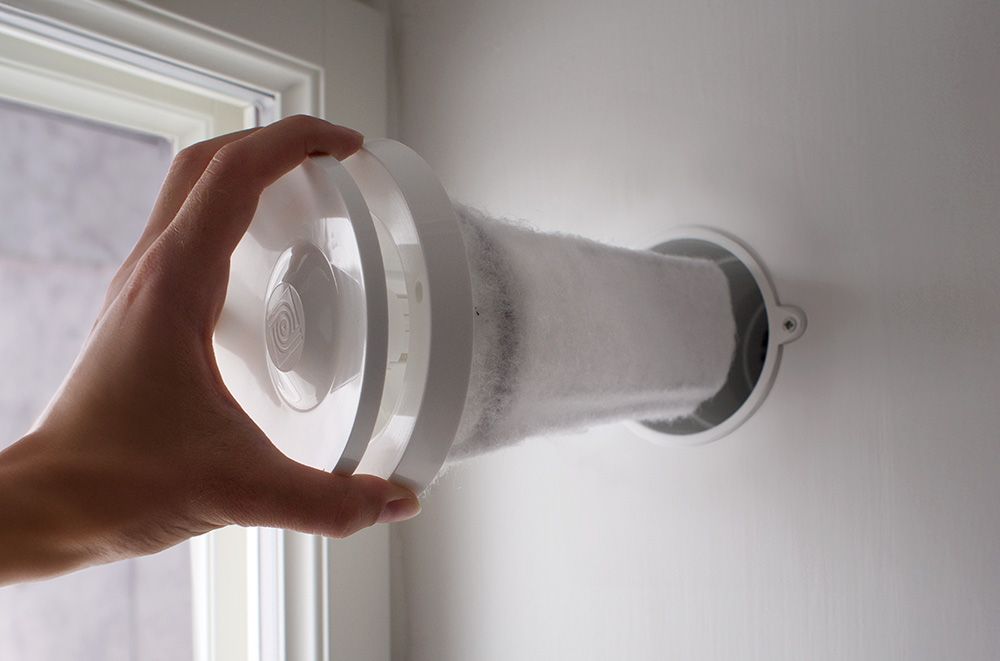
Fresh air valves are used to bring fresh outdoor air into indoor spaces. They are used in buildings with either natural ventilation or mechanical exhaust ventilation.
In mechanical exhaust ventilation, an exhaust fan removes stale air from the building. This creates a pressure difference between the indoor and outdoor air, causing fresh air to flow through the fresh air valve from outside to inside.
In natural ventilation, the temperature difference between outdoor and indoor air, wind, and the pressure difference created by the height of the exhaust flue generate airflow through the exhaust flue and create a pressure difference between the indoor and outdoor air.
Without fresh air valves, ventilation cannot function properly. If the valves are missing, they can also be installed afterwards to improve ventilation.
How the Velco fresh air valve works
How does the thermostat in the Velco fresh air valve work?
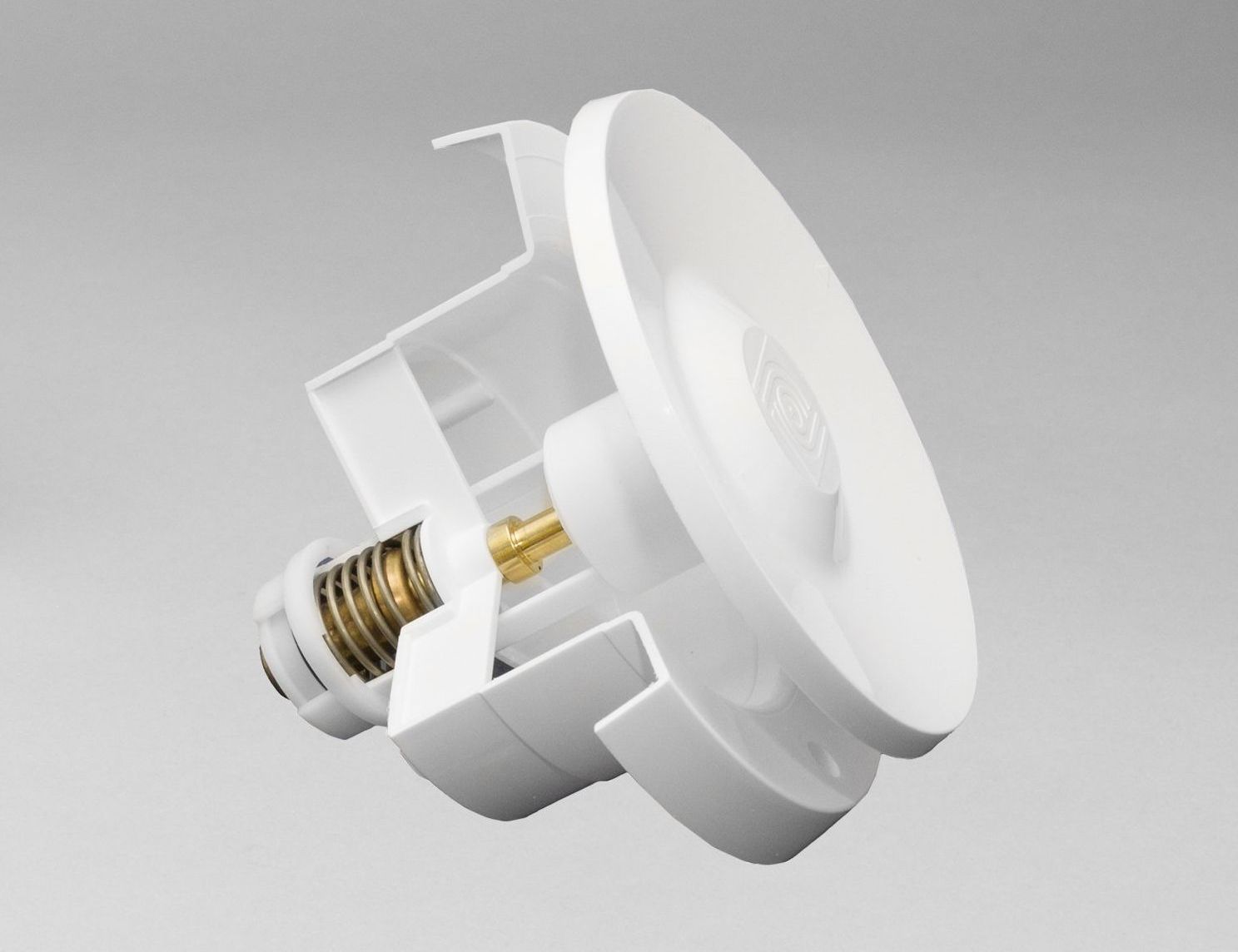
The Velco fresh air valve features a fully automatic, temperature-responsive thermostat that adjusts the opening of the valve disc according to changes in outdoor temperature. When the outdoor temperature is warm, the valve opens further and allows more fresh air to enter. As the temperature drops below freezing, the thermostat automatically reduces the opening and decreases the amount of incoming air.
This helps maintain a comfortable indoor environment without requiring manual adjustment. If needed, the valve can also be adjusted manually, for example, to close it completely for a short period.
Does the Velco fresh air valve require electricity?
No. The Velco fresh air valve does not require electricity. Its thermostat operates entirely mechanically using a temperature-responsive wax element. It automatically adjusts the airflow according to the outdoor temperature without electricity or batteries, providing reliable, worry-free operation all year round.
The valve does not close in freezing temperatures. What is wrong?
During freezing temperatures, the fresh air valve may occasionally fail to reduce its opening. This is very rarely caused by a fault in the valve. Instead, the phenomenon is usually caused by thermal pressure differences, also known as the stack effect.
The stack effect is particularly common on the upper floors of multi-storey buildings. Warm indoor air rises and tends to escape through the upper parts of the building, while cold outdoor air enters through the lower parts. As a result, air may occasionally flow outward through fresh air valves installed on the upper floors.
Because the air flowing outward is warm, the valve's thermostat does not reduce the opening in the same way it would when cold outdoor air flows inward. However, closing the valve is not recommended. If air cannot flow out through the fresh air valve, it may instead be forced through gaps in the building structure. Warm, moist air flowing through the structure can significantly increase the risk of moisture-related damage.
If all bedrooms and living areas have functioning fresh air valves, an occasional change in airflow direction is not harmful and does not require any action. You can check the airflow by placing your hand underneath the valve. If you feel air flowing outward, the valve is acting as an exhaust vent in this situation, and no action is required.
Filter operation and replacement
What does it mean that the filter is electrostatically charged?
The original Velco filters made from 3M Filtrete™ material are treated during manufacturing to create a permanent electrostatic charge. This charge makes the filter work like a magnet: as air passes through the filter, the electrostatic charge attracts and captures airborne pollutants.
Unlike a conventional mechanical filter, an electrostatically charged filter can also capture very small, even microscopic, particles.
How often should the filter be replaced?
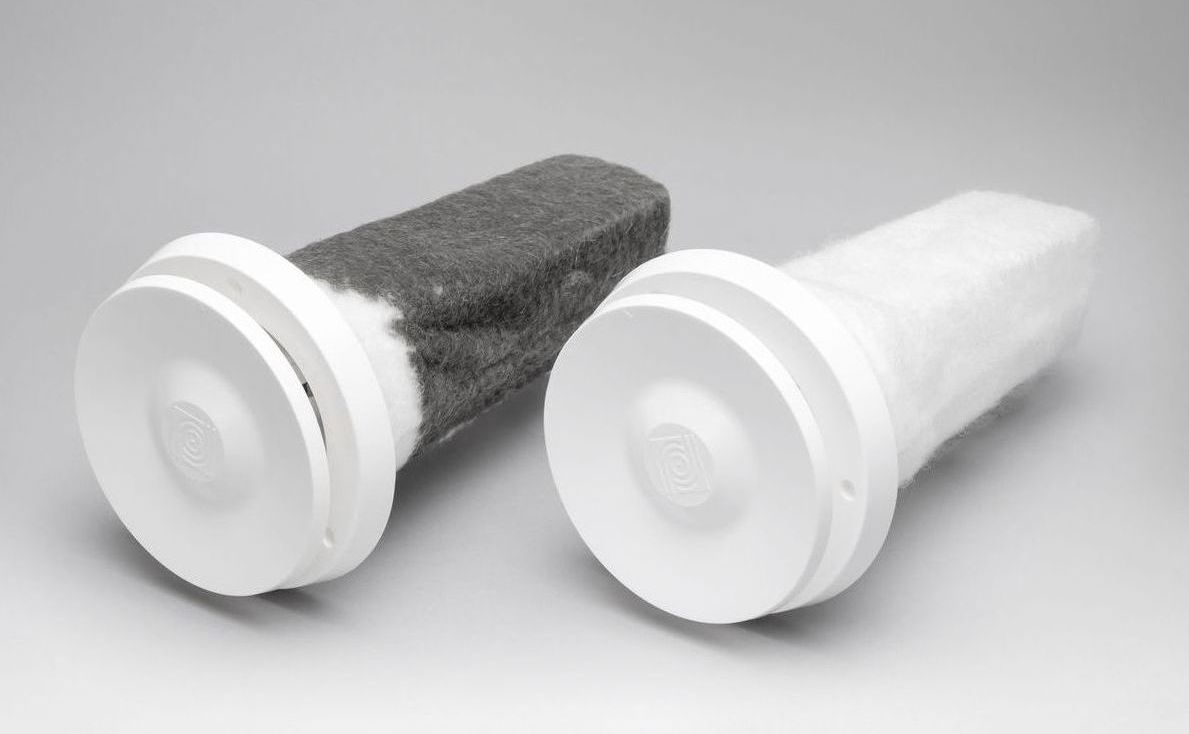
The filter in a Velco fresh air valve should be replaced when it becomes visibly darkened, and at least once a year. If the building is located near a busy road or in an area with high pollen levels, the filter should be checked and replaced more frequently if necessary.
Regular filter replacement helps maintain good indoor air quality and ensures that the fresh air valve continues to function properly. The need for replacement can also be assessed by the colour of the filter: a clean white filter gradually turns grey and darker as it collects pollutants, indicating that it is time for a replacement.
How do I know which replacement filter is right?
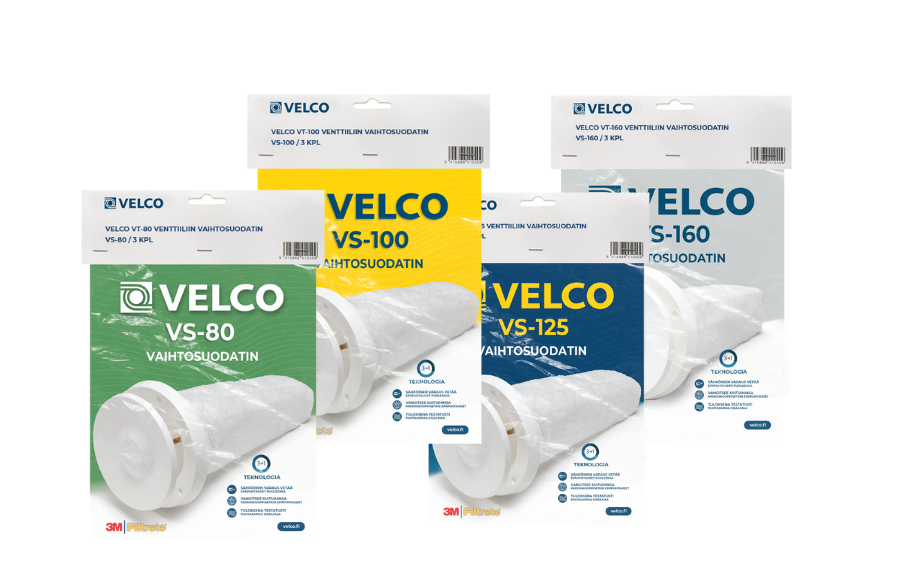
Velco VS replacement filters are designed to fit Velco fresh air valves. The correct filter is determined by the size of the valve. If you are unsure which size your valve is, you can easily check the label on the valve body.
* VT-80 → VS-80
* VT-100 → VS-100
* VT-125 → VS-125
* VT-160 → VS-160
* Mökkiventtiili (VT-100) → Mökkiventtiilisuodatin (shortened VS-100)
How do I replace the filter?
Watch the instructionsWatch the video below to see how to replace the filter, or follow the written instructions via the link below.
Where can I buy replacement filters?
Three-pack replacement filter sets are available from well-stocked hardware and home improvement stores. Always make sure to choose genuine Velco replacement filters. For larger quantities or housing association orders, please contact us directly for a quotation.
Installation
Where should a fresh air valve be installed?
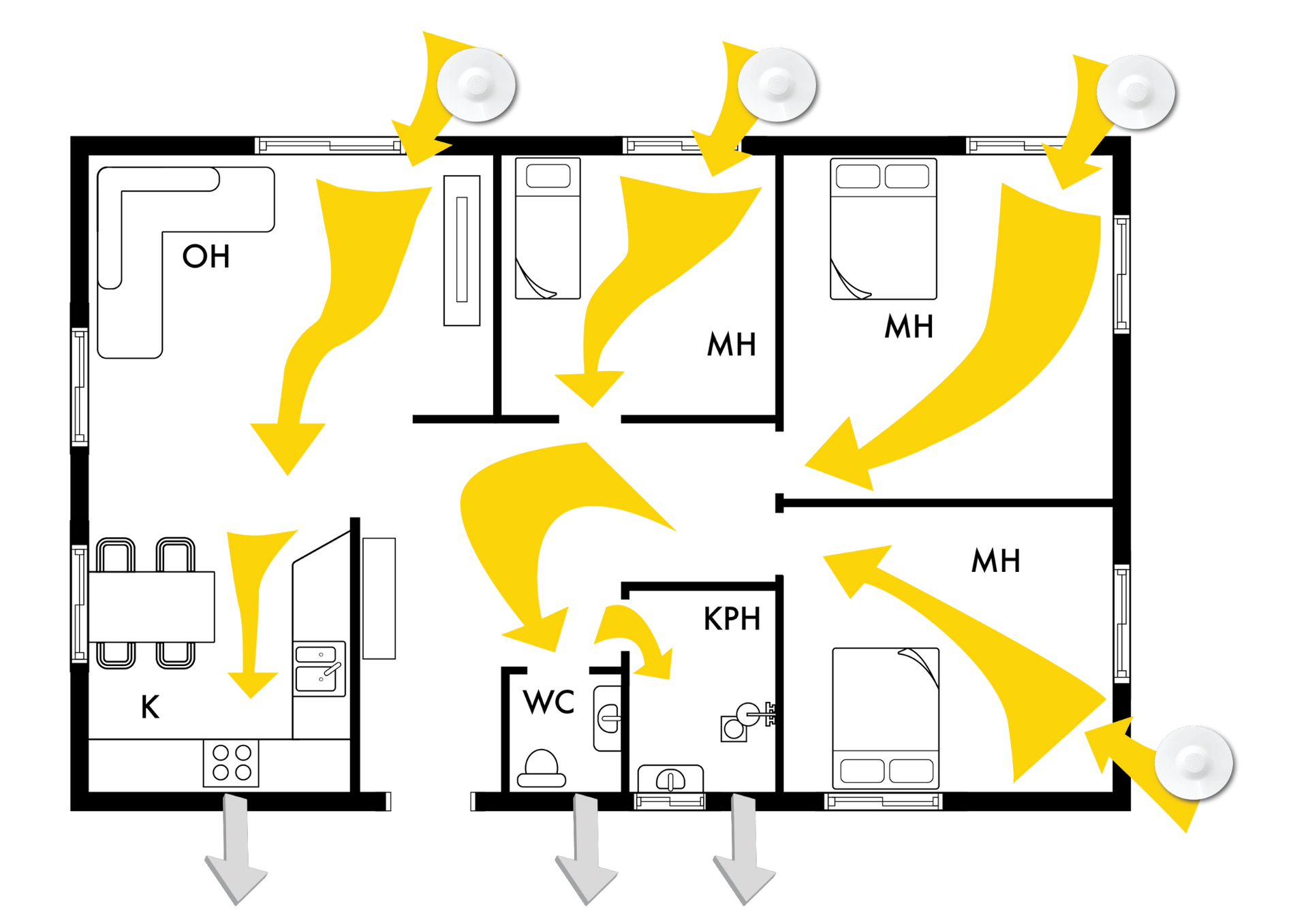
Fresh air valves should be installed in the living areas of the home, such as bedrooms and living rooms (yellow arrow). Fresh air entering through the valves flows through the living spaces towards the exhaust air valves in the kitchen, WC, bathroom, and utility areas (grey arrow), ensuring effective air exchange.
The number of valves can be estimated based on the floor area, with approximately one fresh air valve for every 20 m². However, it is important that every bedroom and living area has at least one fresh air valve.
The best location is as high as possible, for example above a window or radiator. This allows incoming air to warm up and mix with the room air before reaching the occupied zone. The valve should preferably be positioned in the far corner of the room, sufficiently far from an exhaust air valve or flue. Installation close to floor level should be avoided, as cold incoming air may cause draughts and discomfort. It is also advisable to avoid installing the valve directly above sofas, beds, or other areas where people spend time.
1. Bring fresh air into living areas such as bedrooms and living rooms through fresh air valves.
2. Remove exhaust air from so-called wet or contaminated areas, such as the sauna, bathroom, kitchen, and utility room.
3. Ensure that every room has at least one ventilation valve, either a fresh air valve or an exhaust air valve, depending on the purpose of the room.
4. Ensure that air can flow towards the exhaust areas through transfer air routes. These can be provided by a gap under the door or a transfer air grille. If there is no continuous gap or grille, the doors between living areas and exhaust areas can be left slightly ajar.
Is a Velco fresh air valve suitable for a sauna?
The Velco fresh air valve, which automatically adjusts according to the outdoor temperature, is also an excellent choice for saunas. Unlike a manually operated valve, it cannot accidentally be left closed, helping to keep the sauna fresh. Automatic temperature control ensures that ventilation continues to operate effectively throughout the year without requiring constant attention.
The optimal location for a fresh air valve in a sauna is approximately 40–50 cm above the top of the heater stones, positioned to the side of the heater. When the valve is installed above the heater, the incoming air mixes with the warm air rising from the heater.
A fresh air valve should not be installed close to floor level. A low-mounted valve can make the floor colder and, particularly in winter, increase heating demand in a sauna with underfloor heating.
What wall thickness can a Velco fresh air valve be installed in?
Minimum wall thickness with the filter frame and filter installed: 120 mm
Minimum wall thickness without the filter frame and filter (valve only): 90 mm
There is no maximum wall thickness. The telescopic installation ducts can be extended as needed to accommodate thicker walls.
Can I improve ventilation using only Velco fresh air valves?
If a space does not have an exhaust flue, ventilation can be improved by installing two or more Velco fresh air valves on opposite walls. This allows air to circulate through the space, with air entering through one valve and exiting through the other. However, the direction of airflow may vary depending on weather conditions.
The most effective way to provide exhaust ventilation is generally to install a dedicated exhaust duct through the roof.
What size hole saw do I need for installation?
Choosing the correct hole saw size is important to ensure that the wall ducts fit tightly into the wall penetration.
VT-80 = 85 mm hole saw
VT-100 = 105 mm hole saw
VT-125 = 130 mm hole saw
VT-160 = 165 mm hole saw
What size ventilation window can the Velco VTR be installed in?
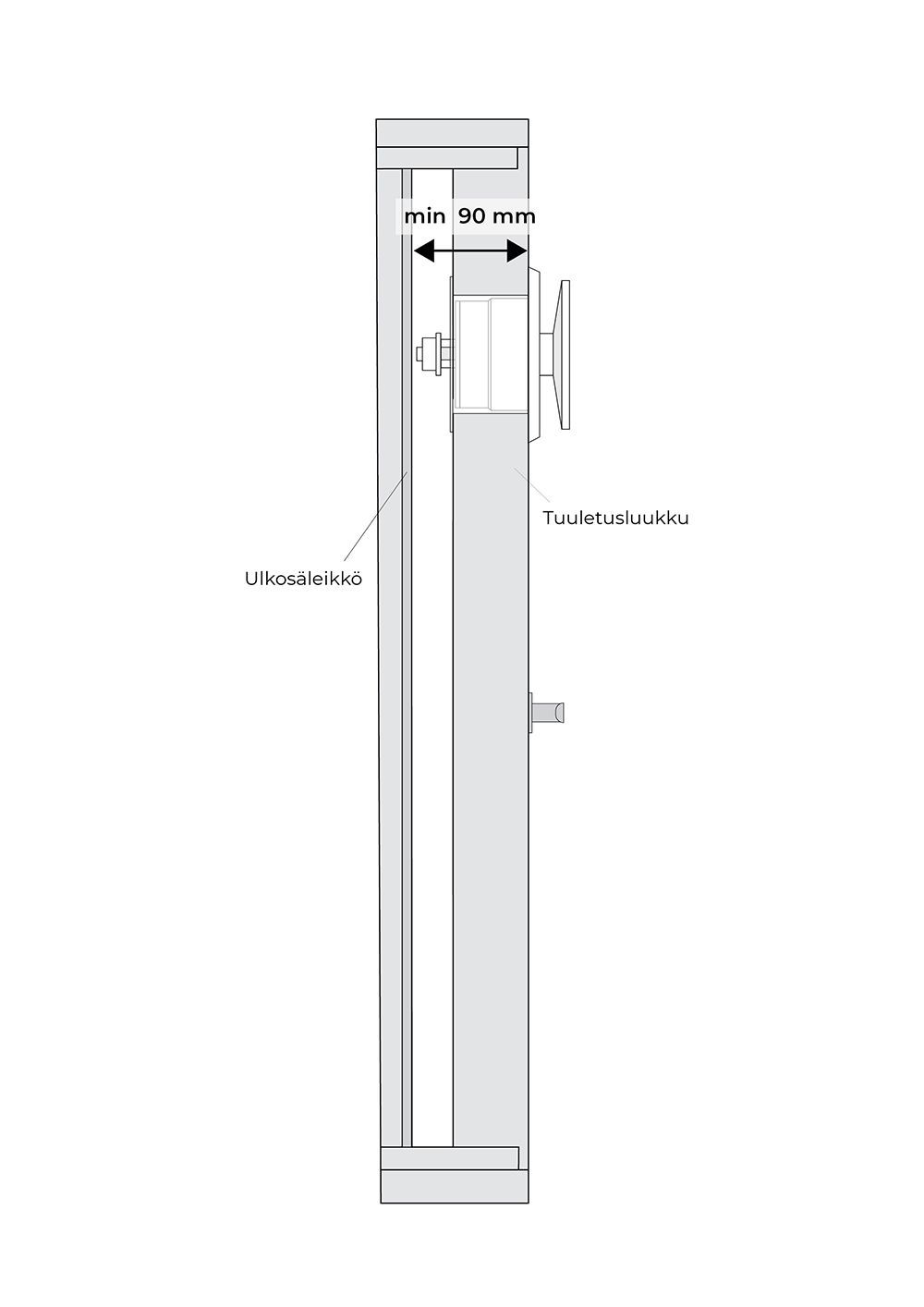
The Velco VTR requires an installation depth of 90 mm to allow sufficient space for the thermostat's movement. If the ventilation window is less than 90 mm deep, 15–30 mm spacer rings can be used to move the valve further out from the inner surface of the hatch.
Another option is to use a manually operated valve, which requires an installation depth of only 50 mm.
Velco VTR is also available in a reduced-size version, making it suitable for narrow ventilation windows or hatches with wooden frames. The reduced-size valve is available for both VT-80 and VT-100 models.
VT-80: standard valve body diameter 147 mm; reduced-size version 93.5 mm
VT-100: standard valve body diameter 147 mm; reduced-size version 110 mm
Does the wall duct need to be sealed when installed?
If the installation hole is the correct size, the valve fits tightly into the wall penetration using a sealing ring, so no additional sealing is necessary.
However, sealing the exterior grille is recommended to prevent rainwater and moisture from entering the structure.
How is the valve adjusted?
A new Velco valve is delivered with a factory setting in which the valve disc closes when the outdoor temperature falls below −5°C and opens fully when the temperature rises above +10°C.
The factory setting can be checked by turning the valve disc. A click from the valve confirms the correct position. To ensure continuous ventilation, turn the valve disc at least half a turn further open from the click position, i.e. to the left. The valve will then remain at least 2 mm open and will not close completely when the outdoor temperature drops.
The minimum opening can be adjusted further if required. For example, in buildings without mechanical exhaust ventilation, it is recommended to turn the valve disc one full turn to the left from the click position to ensure sufficient ventilation.
Fresh air valves and air-source heat pumps
Fresh air valves and air-source heat pumps complement each other, although they serve different purposes. An air-source heat pump does not replace ventilation, as it does not introduce fresh outdoor air but instead recirculates and heats or cools the indoor air. An adequate number of fresh air valves ensures that fresh outdoor air enters the building in a controlled manner. When fresh air enters through the valves, the air-source heat pump can distribute and equalise the temperature throughout the room more effectively.
A fresh air valve can be installed near an air-source heat pump, allowing the incoming fresh air to be efficiently distributed throughout the room. However, the valve should not be installed too close to the heat pump's temperature sensor, as a direct airflow can interfere with the sensor and reduce the accuracy of temperature control.
Installation in a building with mechanical exhaust ventilation
Velco fresh air valves are designed to work reliably in both naturally ventilated buildings and buildings with mechanical exhaust ventilation. The valve uses a thermostat that responds to outdoor temperature and automatically adjusts the airflow opening without requiring manual adjustment.
As the outdoor temperature drops, the thermostat reduces the airflow opening, helping to minimise draughts caused by cold incoming air. As the temperature rises, the opening increases, allowing an adequate supply of fresh air. This supports the operation of mechanical exhaust ventilation and helps maintain balanced ventilation under changing outdoor conditions.
The airtightness of the building affects how the airflow adjustment works. In airtight buildings, ventilation remains controlled even when the airflow opening is reduced, and air continues to enter through the valve. In less airtight buildings, it is important to follow the installation and operating instructions and ensure that the valve never closes completely. This helps prevent uncontrolled air leakage through the building structure.
Do you offer installation services?
We do not offer our own installation services, but our products are widely installed by HVAC contractors and installation companies throughout Finland.
I have a question about product installation
Katso yhteystiedotWhether you are a private customer or a professional, we are happy to help with any questions about our products. You can contact us by phone or email.